出现在书名中的结果
共 19 条

Algorithms for Image Processing and Computer Vision
A cookbook of algorithms for common image processing applications Thanks to advances in computer hardware and software, algorithms have been developed that support sophisticated image processing without requiring an extensive background in mathematics. This bestselling book has been fully updated with the newest of these, including 2D vision methods in content-based searches and the use of graphics cards as image processing computational aids. It’s an ideal reference for software engineers and developers, advanced programmers, graphics programmers, scientists, and other specialists who require highly specialized image processing. Algorithms now exist for a wide variety of sophisticated image processing applications required by software engineers and developers, advanced programmers, graphics programmers, scientists, and related specialists This bestselling book has been completely updated to include the latest algorithms, including 2D vision methods in content-based searches, details on modern classifier methods, and graphics cards used as image processing computational aids Saves hours of mathematical calculating by using distributed processing and GPU programming, and gives non-mathematicians the shortcuts needed to program relatively sophisticated applications. Algorithms for Image Processing and Computer Vision, 2nd Edition provides the tools to speed development of image processing applications.

Hands-On Genetic Algorithms with Python
Explore the ever-growing world of genetic algorithms to build and enhance AI applications involving search, optimization, machine learning, deep learning, NLP, and XAI using Python libraries Key Features Learn how to implement genetic algorithms using Python libraries DEAP, scikit-learn, and NumPy Take advantage of cloud computing technology to increase the performance of your solutions Discover bio-inspired algorithms such as particle swarm optimizat
Mastering Python Scientific Computing
If you are a Python programmer and want to get your hands on scientific computing, this book is for you. The book expects you to have had exposure to various concepts of Python programming.
Mastering OpenCV 4
Mastering OpenCV, now in its third edition, targets computer vision engineers taking their first steps toward mastering OpenCV. Keeping the mathematical formulations to a solid but bare minimum, the book delivers complete projects from ideation to running code, targeting current hot topics in computer vision such as face recognition, landmark detection and pose estimation, and number recognition with deep convolutional networks.You’ll learn from experienced OpenCV experts how to implement computer vision products and projects both in academia and industry in a comfortable package. You’ll get acquainted with API functionality and gain insights into design choices in a complete computer vision project. You’ll also go beyond the basics of computer vision to implement solutions for complex image processing projects.By the end of the book, you will have created various working prototypes with the help of projects in the book and be well versed with the new features of OpenCV4.

Data Labeling in Machine Learning with Python
Take your data preparation, machine learning, and GenAI skills to the next level by learning a range of Python algorithms and tools for data labeling Key Features Generate labels for regression in scenarios with limited training data Apply generative AI and large language models (LLMs) to explore and label text data Leverage Python libraries for image, video, and audio data analysis and data labeling Purchase of the print or Kindle book includ
Mastering openFrameworks:Creative Coding Demystified
This book gives clear and effective instructions, stuffed with practical examples, to build your own fun, stunning and highly-interactive openFrameworks applications. Each chapter is focused differently and has a new theme to it,This book targets visual artists, designers, programmers and those interested in creative coding by getting started with openFrameworks. This book will help you understand the capabilities of openFrameworks to help you create visually stunning and fully interactive applications. You should have a basic knowledge of object oriented programming, such as C++, Java, Python, ActionScript 3, etc.
Mastering OpenCV 4 with Python
OpenCV is considered to be one of the best open source computer vision and machine learning software libraries. It helps developers build complete projects in relation to image processing, motion detection, or image segmentation, among many others. OpenCV for Python enables you to run computer vision algorithms smoothly in real time, combining the best of the OpenCV C++ API and the Python language.In this book, you'll get started by setting up OpenCV and delving into the key concepts of computer vision. You'll then proceed to study more advanced concepts and discover the full potential of OpenCV. The book will also introduce you to the creation of advanced applications using Python and OpenCV, enabling you to develop applications that include facial recognition, target tracking, or augmented reality. Next, you'll learn machine learning techniques and concepts, understand how to apply them in real-world examples, and also explore their benefits, including real-time data production and faster data processing. You'll also discover how to translate the functionality provided by OpenCV into optimized application code projects using Python bindings. Toward the concluding chapters, you'll explore the application of artificial intelligence and deep learning techniques using the popular Python libraries TensorFlow, and Keras.By the end of this book, you'll be able to develop advanced computer vision applications to meet your customers' demands.
Machine Learning with Swift
iOS developers who wish to create smarter iOS applications using the power of machine learning will find this book to be useful. This book will also benefit data science professionals who are interested in performing machine learning on mobile devices. Familiarity with Swift programming is all you need to get started with this book.
Computer Vision Projects with OpenCV and Python 3
Python is the ideal programming language for rapidly prototyping and developing production-grade codes for image processing and Computer Vision with its robust syntax and wealth of powerful libraries. This book will help you design and develop production-grade Computer Vision projects tackling real-world problems.With the help of this book, you will learn how to set up Anaconda and Python for the major OSes with cutting-edge third-party libraries for Computer Vision. You'll learn state-of-the-art techniques for classifying images, finding and identifying human postures, and detecting faces within videos. You will use powerful machine learning tools such as OpenCV, Dlib, and TensorFlow to build exciting projects such as classifying handwritten digits, detecting facial features,and much more. The book also covers some advanced projects, such as reading text from license plates from real-world images using Google’s Tesseract software, and tracking human body poses using DeeperCut within TensorFlow.By the end of this book, you will have the expertise required to build your own Computer Vision projects using Python and its associated libraries.

Hands-On Graph Neural Networks Using Python
Design robust graph neural networks with PyTorch Geometric by combining graph theory and neural networks with the latest developments and apps Purchase of the print or Kindle book includes a free PDF eBook Key Features Implement -of-the-art graph neural architectures in Python Create your own graph datasets from tabular data Build powerful traffic forecasting, recommender systems, and anomaly detection applications Book Description G
Building Computer Vision Projects with OpenCV 4 and C++
OpenCV is one of the best open source libraries available and can help you focus on constructing complete projects on image processing, motion detection, and image segmentation.This Learning Path is your guide to understanding OpenCV concepts and algorithms through real-world examples and activities. Through various projects, you'll also discover how to use complex computer vision and machine learning algorithms and face detection to extract the maximum amount of information from images and videos. In later chapters, you'll learn to enhance your videos and images with optical flow analysis and background subtraction. Sections in the Learning Path will help you get to grips with text segmentation and recognition, in addition to guiding you through the basics of the new and improved deep learning modules. By the end of this Learning Path, you will have mastered commonly used computer vision techniques to build OpenCV projects from scratch. This Learning Path includes content from the following Packt books:Mastering OpenCV 4 - Third Edition by Roy Shilkrot and David Millán Escrivá.Learn OpenCV 4 By Building Projects - Second Edition by David Millán Escrivá, Vinícius G. Mendonça, and Prateek Joshi.
电子信息与通信工程专业英语 第3版
本书是为高等院校电子信息与通信工程类专业学生编写的专业英语教材。本书系统、全面地介绍了专业英语的基础知识,精心编选了与电子信息、通信工程专业相关的课文和阅读材料,不仅包括传统的专业基础知识,还包括近些年正蓬勃发展的新的专业知识。全书共分三篇,分别为基础篇、专业篇、应用篇。基础篇介绍科技英语的基础知识;专业篇涵盖本科学习的主要专业基础课内容和热点技术,包括电路系统与设计、信号系统和信号处理、通信技术、人工智能等方面的内容;应用篇主要从阅读、翻译、写作等角度提高学生对专业英语的应用能力。每章后均附有书中专业篇课文及阅读材料对应的中文翻译,供学生和教师参考。本书可作为高等院校电子信息与通信工程等相关专业的本科生“专业英语”课程的教材,也可用作相关专业研究生的课外读物,还可供相关科技人员学习和参考。
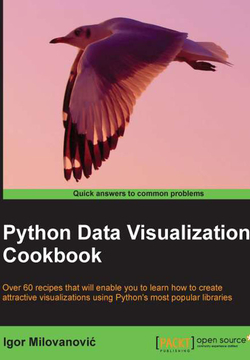
Python Data Visualization Cookbook
This book is written in a Cookbook style targeted towards an advanced audience. It covers the advanced topics of data visualization in Python.Python Data Visualization Cookbook is for developers that already know about Python programming in general. If you have heard about data visualization but you don't know where to start, then this book will guide you from the start and help you understand data, data formats, data visualization, and how to use Python to visualize data.You will need to know some general programming concepts, and any kind of programming experience will be helpful, but the code in this book is explained almost line by line. You don't need maths for this book, every concept that is introduced is thoroughly explained in plain English, and references are available for further interest in the topic.
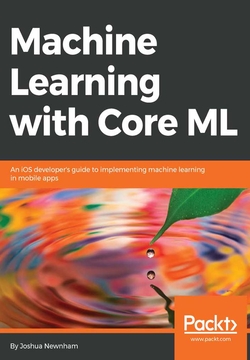
Machine Learning with Core ML
Machine Learning with Core ML is for you if you are an intermediate iOS developer interested in applying machine learning to your mobile apps. This book is also for those who are machine learning developers or deep learning practitioners who want to bring the power of neural networks in their iOS apps. Some exposure to machine learning concepts would be beneficial but not essential, as this book acts as a launchpad into the world of machine learning for developers.
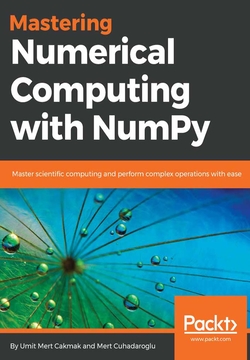
Mastering Numerical Computing with NumPy
Mastering Numerical Computing with NumPy is for you if you are a Python programmer, data analyst, data engineer, or a data science enthusiast, who wants to master the intricacies of NumPy and build solutions for your numeric and scientific computational problems. You are expected to have familiarity with mathematics to get the most out of this book.
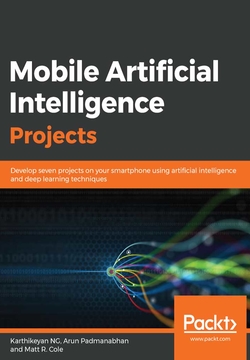
Mobile Artificial Intelligence Projects
We’re witnessing a revolution in Artificial Intelligence, thanks to breakthroughs in deep learning. Mobile Artificial Intelligence Projects empowers you to take part in this revolution by applying Artificial Intelligence (AI) techniques to design applications for natural language processing (NLP), robotics, and computer vision.This book teaches you to harness the power of AI in mobile applications along with learning the core functions of NLP, neural networks, deep learning, and mobile vision. It features a range of projects, covering tasks such as real-estate price prediction, recognizing hand-written digits, predicting car damage, and sentiment analysis. You will learn to utilize NLP and machine learning algorithms to make applications more predictive, proactive, and capable of making autonomous decisions with less human input. In the concluding chapters, you will work with popular libraries, such as TensorFlow Lite, CoreML, and PyTorch across Android and iOS platforms.By the end of this book, you will have developed exciting and more intuitive mobile applications that deliver a customized and more personalized experience to users.
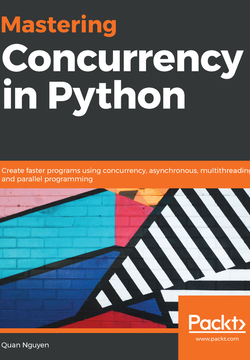
Mastering Concurrency in Python
Python is one of the most popular programming languages, with numerous libraries and frameworks that facilitate high-performance computing. Concurrency and parallelism in Python are essential when it comes to multiprocessing and multithreading; they behave differently, but their common aim is to reduce the execution time. This book serves as a comprehensive introduction to various advanced concepts in concurrent engineering and programming.Mastering Concurrency in Python starts by introducing the concepts and principles in concurrency, right from Amdahl's Law to multithreading programming, followed by elucidating multiprocessing programming, web scraping, and asynchronous I/O, together with common problems that engineers and programmers face in concurrent programming. Next, the book covers a number of advanced concepts in Python concurrency and how they interact with the Python ecosystem, including the Global Interpreter Lock (GIL). Finally, you'll learn how to solve real-world concurrency problems through examples.By the end of the book, you will have gained extensive theoretical knowledge of concurrency and the ways in which concurrency is supported by the Python language
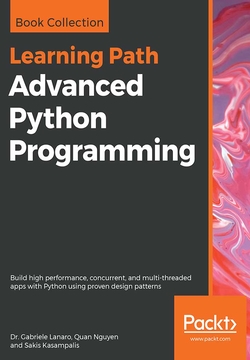
Advanced Python Programming
This Learning Path shows you how to leverage the power of both native and third-party Python libraries for building robust and responsive applications. You will learn about profilers and reactive programming, concurrency and parallelism, as well as tools for making your apps quick and efficient. You will discover how to write code for parallel architectures using TensorFlow and Theano, and use a cluster of computers for large-scale computations using technologies such as Dask and PySpark. With the knowledge of how Python design patterns work, you will be able to clone objects, secure interfaces, dynamically choose algorithms, and accomplish much more in high performance computing.By the end of this Learning Path, you will have the skills and confidence to build engaging models that quickly offer efficient solutions to your problems.This Learning Path includes content from the following Packt products:Python High Performance - Second Edition by Gabriele Lanaro.Mastering Concurrency in Python by Quan Nguyen.Mastering Python Design Patterns by Sakis Kasampalis.
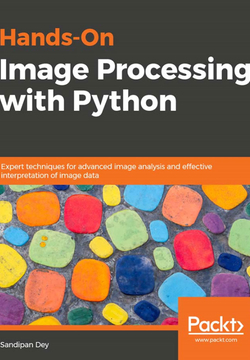
Hands-On Image Processing with Python
Image processing plays an important role in our daily lives with various applications such as in social media (face detection), medical imaging (X-ray, CT-scan), security (fingerprint recognition) to robotics & space. This book will touch the core of image processing, from concepts to code using Python.The book will start from the classical image processing techniques and explore the evolution of image processing algorithms up to the recent advances in image processing or computer vision with deep learning. We will learn how to use image processing libraries such as PIL, scikit-mage, and scipy ndimage in Python. This book will enable us to write code snippets in Python 3 and quickly implement complex image processing algorithms such as image enhancement, filtering, segmentation, object detection, and classification. We will be able to use machine learning models using the scikit-learn library and later explore deep CNN, such as VGG-19 with Keras, and we will also use an end-to-end deep learning model called YOLO for object detection. We will also cover a few advanced problems, such as image inpainting, gradient blending, variational denoising, seam carving, quilting, and morphing.By the end of this book, we will have learned to implement various algorithms for efficient image processing.
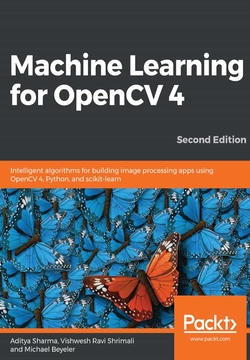
Machine Learning for OpenCV 4(Second Edition)
OpenCV is an opensource library for building computer vision apps. The latest release, OpenCV 4, offers a plethora of features and platform improvements that are covered comprehensively in this up-to-date second edition.You'll start by understanding the new features and setting up OpenCV 4 to build your computer vision applications. You will explore the fundamentals of machine learning and even learn to design different algorithms that can be used for image processing. Gradually, the book will take you through supervised and unsupervised machine learning. You will gain hands-on experience using scikit-learn in Python for a variety of machine learning applications. Later chapters will focus on different machine learning algorithms, such as a decision tree, support vector machines (SVM), and Bayesian learning, and how they can be used for object detection computer vision operations. You will then delve into deep learning and ensemble learning, and discover their real-world applications, such as handwritten digit classification and gesture recognition. Finally, you’ll get to grips with the latest Intel OpenVINO for building an image processing system.By the end of this book, you will have developed the skills you need to use machine learning for building intelligent computer vision applications with OpenCV 4.