出现在书名中的结果
共 20 条

Debugging Machine Learning Models with Python
Master reproducible ML and DL models with Python and PyTorch to achieve high performance, explainability, and real-world success Key Features Learn how to improve performance of your models and eliminate model biases Strategically design your machine learning systems to minimize chances of failure in production Discover advanced techniques to solve real-world challenges Purchase of the print or Kindle book includes a free PDF eBook <h

Feature Engineering for Modern Machine Learning with Scikit-Learn
Feature engineering is essential for building robust predictive models. This book delves into practical techniques for transforming raw data into powerful features using Scikit-Learn. You'll explore automation, deep learning integrations, and advanced topics like feature selection and model evaluation. Learn to handle real-world data challenges, enhance accuracy, and streamline your workflows. Through hands-on projects, readers will gain practical experience with techniques such as clustering, pipelines, and feature selection, applied to domains like retail and healthcare. Step-by-step instructions ensure a comprehensive learning journey, from foundational concepts to advanced automation and hybrid modeling approaches. By combining theory with real-world applications, the book equips data professionals with the tools to unlock the full potential of machine learning models. Whether working with structured datasets or integrating deep learning features, this guide provides actionable insights to tackle any data transformation challenge effectively.

AI-Native LLM Security
Unlock the secrets to safeguarding AI by exploring the top risks, essential frameworks, and cutting-edge strategies—featuring the OWASP Top 10 for LLM Applications and Generative AI DRM-free PD

工业智能:方法与应用
为了促进智能制造的发展进程,本书对工业智能的方法和应用展开了详细的阐述。工业智能涉及的方法和应用极其广泛,本书从工业过程中的设计、制造、运维三大活动展开,介绍了当前工业智能领域的热点研究。本书共5篇。第1篇(第1、2章)概述了智能制造的概念、参考模型及核心,引申出了工业智能的概念和典型分类。第2篇(第3、4、5章)分别从结构设计的特征识别与优化、设计文档结构化分析和装配工艺智能设计展开。第3篇(第6、7、8章)分别介绍了工业缺陷图像智能检测、人员作业行为检测与监控和制造过程的人机协同。第4篇(第9、10章)介绍了生产作业运行智能管控和设备故障诊断与预防性维修。第5篇(第11、12章)介绍了数字孪生与工业智能,以及AI+AR辅助下的制造知识。本书的主要读者对象是数字化工程应用领域和智能制造领域的设计、制造、运维和管理人员,高校相关专业的研究人员,以及对工业智能技术感兴趣的专业人士。

Programming Neural Networks with Python
This book offers a comprehensive guide to understanding and programming neural networks and deep learning. Starting with the basics, readers will learn how to build neural networks using Python and TensorFlow. By the end, they’ll master key algorithms and techniques to apply them to real-world machine learning challenges. The book walks through the development of simple perceptrons and progresses to complex multilayer networks, showing how deep learning methods work in practice. The evolution of neural networks is explored, from the origins of artificial neurons to cutting-edge deep learning architectures. Along the way, readers will learn about the different types of neural networks, including convolutional and transformer networks. The book also delves into optimization techniques like gradient descent and backpropagation. Hands-on coding exercises ensure practical learning, preparing readers to implement neural networks for tasks like image recognition, natural language processing, and data classification. By the end of the book, readers will be equipped to apply neural networks to solve diverse AI problems effectively.
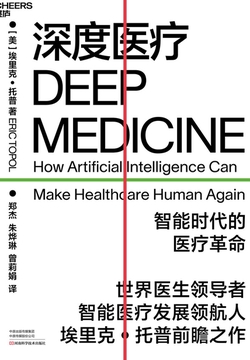
深度医疗
7人今日阅读 推荐值 80.8%
全书共包括13个部分,分别讲述了深度医疗的模型、浅度医疗的概况、人工智能对医疗诊断的影响、人工智能的成功先例、深度学习的局限、人工智能对三类“有模式”医生的影响、人工智能对“无模式”医生的影响、人工智能在心理健康领域的应用、人工智能对医疗系统的影响、人工智能如何改变生物医学、人工智能在个性化饮食方案制定上的应用前景、虚拟医疗助手的发展现状,以及深度共情如何让医疗回归人文。
7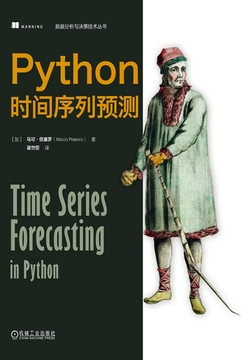
Python时间序列预测
6人今日阅读
本书教你如何从基于时间的数据(如日志、客户分析和其他事件流)中获得即时、有意义的预测。在这本通俗易懂的书中,作者通过带有注释的Python代码进行全面演示,你将学习用于时间序列预测的统计和深度学习方法。通过跟随书中的实例锻炼你的技能,你很快就会准备好建立自己的准确、有洞察力的预测。
6
Modern Time Series Forecasting with Python
Predicting the future, whether it's market trends, energy demand, or website traffic, has never been more crucial. This practical, hands-on guide empowers you to build and deploy powerful time series forecasting models. Whether you’re working with traditional statistical methods or cutting-edge deep learning architectures, this book provides structured learning and best practices for both. Starting with the basics, this data science book introduces fundamental time series concepts, such as ARIMA and exponential smoothing, before gradually progressing to advanced topics, such as machine learning for time series, deep neural networks, and transformers. As part of your fundamentals training, you’ll learn preprocessing, feature engineering, and model evaluation. As you progress, you’ll also explore global forecasting models, ensemble methods, and probabilistic forecasting techniques. This new edition goes deeper into transformer architectures and probabilistic forecasting, including new content on the latest time series models, conformal prediction, and hierarchical forecasting. Whether you seek advanced deep learning insights or specialized architecture implementations, this edition provides practical strategies and new content to elevate your forecasting skills. *Email sign-up and proof of purchase required
人工智能怎么学
1人今日阅读
人工智能怎么学》(ISBN 978-7-5478-5682-6)一书,荣获2023年度“吴文俊人工智能科学技术奖”科技进步奖(科普项目)。 该书为读者可视化地呈现了人工智能领域的知识架构、学习路线、常用教材、在线课程、学习工具和常用网站,从而全方位地为读者学习人工智能提供指引,帮助读者精准而高效地学习人工智能,达到快速入门和进阶的目的。 全书内容包括7个部分:第1部分阐述“人工智能是什么”的问题;第2部分解决“人工智能学什么”的问题,即要从理论基础、编程技术、专业领域知识三个层面进行人工智能的学习;第3~第5部分为第2部分的具体展开,描述“人工智能怎么学”的问题,即分别描述了人工智能的理论基础、编程技术、专业领域知识这三个层面该怎么学;第6部分解决“人工智能前沿信息获取”的问题;第7部分解决“人工智能论文写作与发表”的问题。 本书读者对象主要包括入门人工智能或者转行从事人工智能的人士、人工智能领域的开发人员,以及人工智能的基础研究人员等。
1
Time Series Analysis with Python Cookbook
1人今日阅读 推荐值 79.3%
Perform time series analysis and forecasting confidently with this Python code bank and reference manual. Access exclusive GitHub bonus chapters and hands-on recipes covering Python setup, probabilistic deep learning forecasts, frequency-domain analysis, large-scale data handling, databases, InfluxDB, and advanced visualizations.
1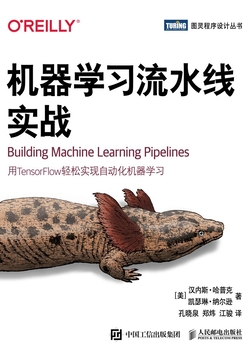
机器学习流水线实战
本书介绍如何构建完整的机器学习流水线,从而在生产环境中准备数据以及训练、验证、部署和管理机器学习模型。你将了解机器学习流水线的每个环节,以及如何利用TensorFlow Extended(TFX)构建机器学习流水线。模型的生命周期是一个闭环,其中包括数据读取、数据校验、数据预处理、模型训练、模型分析、模型验证、模型部署、模型反馈等环节。你将学习如何利用Beam、Airflow、Kubeflow、TensorFlow Serving等工具将每一个环节的工作自动化。学完本书,你将不再止步于训练单个模型,而是能够从更高的角度将模型产品化,从而为公司创造更大的价值。
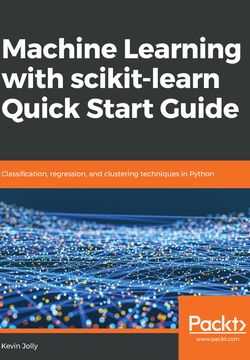
Machine Learning with scikit:learn Quick Start Guide
Scikit-learn is a robust machine learning library for the Python programming language. It provides a set of supervised and unsupervised learning algorithms. This book is the easiest way to learn how to deploy, optimize, and evaluate all of the important machine learning algorithms that scikit-learn provides.This book teaches you how to use scikit-learn for machine learning. You will start by setting up and configuring your machine learning environment with scikit-learn. To put scikit-learn to use, you will learn how to implement various supervised and unsupervised machine learning models. You will learn classification, regression, and clustering techniques to work with different types of datasets and train your models.Finally, you will learn about an effective pipeline to help you build a machine learning project from scratch. By the end of this book, you will be confident in building your own machine learning models for accurate predictions.

Azure Data and AI Architect Handbook
Master core data architecture design concepts and Azure Data & AI services to gain a cloud data and AI architect’s perspective to developing end-to-end solutions Purchase of the print or Kindle book includes a free PDF eBook Key Features Translate and implement conceptual architectures with the right Azure services Inject artificial intelligence into data solutions for advanced analytics Leverage cloud computing and frameworks to drive data science wo

智能医疗:医学人工智能的未来
本书是医学博士、心脏病专家安东尼·常撰写的一本关于人工智能与生物医学高度融合发展的专著,为读者提供了人工智能发展对医学领域影响这一主题颇具洞察力的评论。第一部分介绍了人工智能的相关术语,阐述了其基本概念,并探讨了神经科学与人工智能的关系。该部分还描绘了人工智能的早期发展和它在医学中的历史。人工智能的起源及其在医学中的应用是理解当今技术水平的关键。在这一节中也包含了其他入门知识,比如对医学人工智能的常见误解,并附有简要的解释。第二部分详细介绍了生物医学数据科学和人工智能的现状,并涵盖了医疗数据、数据库和生物医学数据科学的基本要素。人工智能当前最常用的方法论,即机器学习和深度学习,是本节的主要部分。其他关键概念,如认知计算、自然语言处理和机器人科学,也包含于本节中。这一节还给出了一种建议策略,要通过知识评估来学习医学人工智能的基础知识(答案可以在汇编中找到)。第三部分涵盖了人工智能在医学不同领域的应用,以及对临床医生认知方面的概论。遵循这个方向,分别讨论了人工智能在不同子领域、尤其是在医学人工智能的前沿子领域的应用。本节包括一些有用的指南(组织评估以及在医学中成功实施人工智能的困难和要素)。第四部分介绍了医学人工智能及其应用的未来。从增强和虚拟现实、万物互联网等元素来讨论人工智能的未来。还简要介绍了虚拟助理和量子计算等其他关键概念。与医学相关的人工智能的未来将单独讨论。本节的末尾将总结医学人工智能的要点。

技术视角的数字法学研究
本书研究的是法律人工智能的基本定位、方法和中国实践的七个维度,包括在数字法学中的定位,计算机的建模思维和科研范式,作为社会现象的智慧司法工程的工程实践,算法解释技术和用户效果反馈,法律专家对法律人工智能的质疑观点和技术回应,法律人工智能技术对法律定量研究的贡献,大模型时代的法律职业和技能等内容。

Deep Learning with C++
1人今日阅读
Deep learning systems often struggle to meet performance demands in real-time and production environments. This book shows you how to build high-performance deep learning systems in C++, enabling efficient and scalable artificial intelligence (AI) in resource-constrained environments where performance matters. You’ll start by setting up a complete C++ deep learning environment and implementing core neural networks from scratch. As you progress, you’ll build advanced architectures, including Convolutional Neural Networks (CNNs), Recurrent Neural Networks (RNNs), Long Short-Term Memory Networks (LSTMs), Generative Adversarial Networks (GANs), and Transformers, using C++, CUDA, and PyTorch’s C++ API. The book then focuses on model quantization and compression. It will guide you through the model deployment process in production with robust monitoring and explainability. You’ll also explore distributed training and techniques for real-time inference in performance-critical domains. By the end of this book, you’ll be able to design, optimize, and deploy deep learning systems in C++ that are production-ready, scalable, and efficient across multiple industries. *Email sign-up and proof of purchase required
1
面向智能制造的机器智能理论与方法
本书面向智能制造,将机器智能领域的结构模拟、功能模拟、行为模拟与机制模拟方法贯穿应用于制造全过程,阐明机器智能技术发展对制造业的深刻影响,为制造业的智能化改造升级提供参考。在理论方法上,本书从信息理论视角出发,将“数据-信息-知识-智能”转换作为阐述智能科学发展的主线;在应用场景上,本书围绕智能制造全流程涉及的要素,将“产品-工艺-装备-决策”作为介绍机器智能理论方法在智能制造中应用的主线。通过两条主线的贯穿,可以给读者完整的知识、统一的理论和聚焦的应用场景,提升了读者系统化的科学视角高度,也更加落地而具有实用性。本书可作为高等院校智能科学与技术、机械工程、工业工程、自动化、计算机科学、数据科学等相关专业高年级本科生和研究生的教材和参考用书,也适合对智能科学、智能制造有兴趣的广大读者阅读。

Cracking the Data Science Interview
Rise above the competition and excel in your next interview with this one-stop guide to Python, SQL, version control, statistics, machine learning, and much more Key Features Acquire highly sought-after skills of the trade, including Python, SQL, statistics, and machine learning Gain the confidence to explain complex statistical, machine learning, and deep learning theory Extend your expertise beyond model development with version control, shell scrip

人工智能与椎体骨折诊断
人体的某些结构设计巧妙,骨骼排列复杂,脊柱椎体骨折是脊柱外科医生诊疗中最常见的疾病,尽管影像学技术发展很成熟,但发生骨折时,临床上还是会存在“误诊”的可能。因而借助人工智能技术,辅助脊柱椎体骨折的诊断,能最大地程度提高椎体骨折的确诊率。本书共分为人工智能、椎体骨折、人工智能在脊柱椎体骨折诊断中的未来与展望三篇,主要介绍了人工智能的基本原理,人工智能与医学,脊柱椎体的构成和解剖学特点,脊柱椎体的骨折分类与危险因素,脊柱椎体的生物力学,脊柱椎体骨折的评估与影像学诊断,人工智能在脊柱外科中的应用与展望,人工智能医疗在椎体骨折中的挑战、机遇与思考,人工智能在医疗领域的现状和未来等内容。

RESTful API Design Patterns and Best Practices
Learn how to build robust, future-proof APIs by applying the latest industry best practices, avoiding common pitfalls, and understanding anti-patterns Free with your book: DRM-free PDF version +